
The I-751 abuse waiver: no government fee, and no evaluation required
If you hold a two-year conditional green card through an abusive spouse, you can ask to remove the conditions without them. The battery or extreme cruelty waiver has a $0 government filing fee as of October 2026 (Form G-1055), and the USCIS Policy Manual says you are not required to submit a recommendation from a mental health professional.
Current as of October 2026. We re-check this page every quarter and after any change in the law.
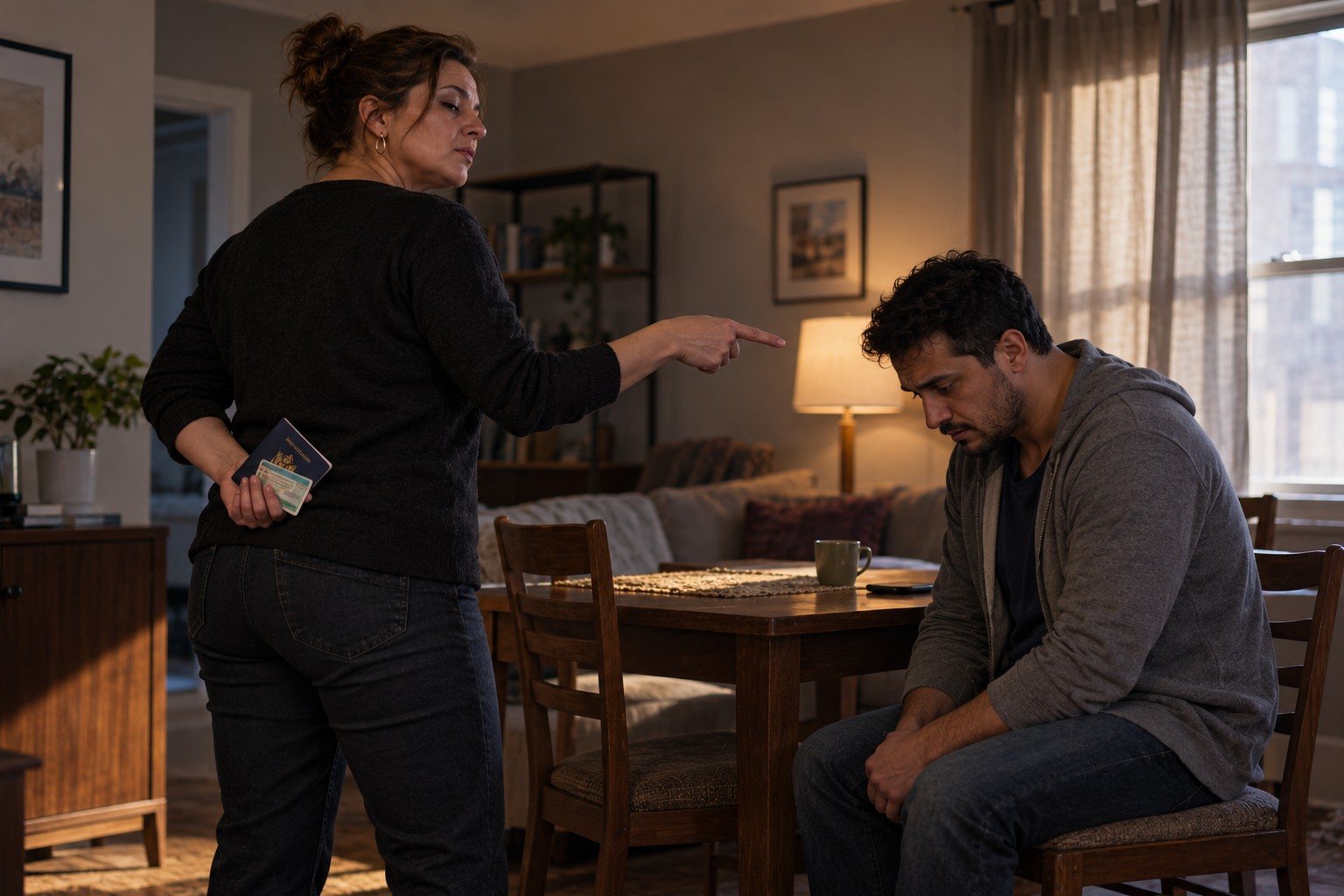
This post is dated October 26, 2026. It is for anyone whose green card has an expiration date two years out because it came through a recent marriage, and whose spouse is abusive. Two worries keep people from filing: the cost, and the belief that they need a psychologist's report. Neither stands in the way.
The waiver in one paragraph

The conditions on residence are normally removed by a joint I-751 filed with your spouse. The statute lets you file without them if the marriage was entered in good faith and you or your child was battered or subjected to extreme cruelty by your spouse or parent (INA 216(c)(4)(C)). USCIS must consider any credible evidence (INA 216(c)(4)). The statute also has an extreme-hardship basis, a good-faith divorce basis, and an intended-spouse basis (INA 216(c)(4)(A), (B), (D)); this post is about the abuse basis.
The government filing fee: $0

| Who files | Government filing fee, as of October 2026 | Source |
|---|---|---|
| Ordinary I-751, paper | $750 | Form G-1055 (ed. 10/16/26) |
| Ordinary I-751, online | $700 | Form G-1055 (ed. 10/16/26) |
| Waiver of the joint filing requirement based on battery or extreme cruelty | $0 | Form G-1055 (ed. 10/16/26) |
The $0 government filing fee covers the conditional resident, spouse or child who files the waiver based on battery or extreme cruelty, as of October 2026 (Form G-1055, ed. 10/16/26, I-751 entry). Our legal fee is separate and is set out at a consultation. Fees change; check uscis.gov/i-751 before you file.
No mental health evaluation required

The regulation at 8 C.F.R. 216.5(e)(3)(iv)-(vii) still prints evaluation rules for extreme cruelty claims. The USCIS Policy Manual says that text is superseded. Conditional residents seeking the battery or extreme cruelty waiver "are not required to submit a recommendation from a mental health professional," and 8 C.F.R. 216.5(e)(3)(iv)-(vii) is superseded by VAWA 1994 sec. 40702 (6 USCIS-PM I.5(C) and fn. 37; Pub. L. 103-322, sec. 40702).
The Policy Manual adds that officers cannot deny the waiver because a particular piece of evidence was not provided (6 USCIS-PM I.5(C)). If you already see a counselor or therapist, their records can still help. You do not need to start treatment to file.
What helps instead is a detailed declaration in your own words and whatever else credibly shows the abuse and the good-faith marriage, since USCIS must consider any credible evidence (INA 216(c)(4)). See writing your declaration.
Timing

You do not have to wait for the 90-day window before the card expires. You may request the abuse waiver at any time after you receive conditional residence, while still married, separated or divorced. It must be filed before a final order of removal (6 USCIS-PM I.5; 8 C.F.R. 216.5(a)(1)(iii), (a)(2), (e)(3)(ii)).
File before any final order of removal
If you are already in immigration court, tell your lawyer now. The waiver has to be filed before the case ends in a final order.
If you claim more than one basis
You can check more than one waiver basis. If you do, USCIS approves on the abuse basis first, and the federal confidentiality rule in 8 U.S.C. 1367 covers the whole petition (6 USCIS-PM I.5(C)). USCIS decides the waiver first; if it is denied, an immigration judge can review it in removal proceedings (Matter of Stowers, 22 I&N Dec. 605 (BIA 1999)). There, DHS bears the burden of proving by a preponderance that the facts supporting termination are true (INA 216(b)(2), (c)(3)(D); 8 C.F.R. 216.4(d)(2), 216.5(f)).
Your spouse is not asked to sign
The waiver is filed without your spouse. A safety plan is made with an advocate. The National Domestic Violence Hotline is 1-800-799-7233, or text START to 88788. If you are in danger now, call 911.
For a private consultation, call (718) 484-7510.
Read next: the battered-spouse I-751 waiver, VAWA, U visa or I-751 waiver, or VAWA fee exemptions in 2026.
Common questions
How much does the I-751 cost if I file the abuse waiver?
The government filing fee is $0 for a conditional resident, spouse or child who files a waiver of the joint filing requirement based on battery or extreme cruelty, as of October 2026 (Form G-1055, ed. 10/16/26, I-751 entry). The ordinary I-751 government filing fee is $750 on paper or $700 online, as of October 2026.
Do I need a psychologist's report for the abuse waiver?
No. The Policy Manual says conditional residents seeking the battery or extreme cruelty waiver are not required to submit a recommendation from a mental health professional, and that 8 C.F.R. 216.5(e)(3)(iv)-(vii) is superseded (6 USCIS-PM I.5(C) and fn. 37). A professional's evaluation can still be evidence if you have one.
Do I have to wait for the 90-day window or for a divorce?
No. You may request the waiver at any time after you receive conditional residence, and you may file while still married, separated or divorced, as long as you file before a final order of removal (6 USCIS-PM I.5; 8 C.F.R. 216.5(a)(1)(iii), (a)(2), (e)(3)(ii)).
The lawyers who will handle your case
One of them calls you back, privately, on your terms.



Talk to a lawyer privately. You decide how we reach you.
Tell us a safe number or email and a safe time, and whether we can leave a message. We never contact the person who hurt you, and we never call from a number or send anything that names this site. The first conversation is free and confidential, in English, Russian, Spanish or Uzbek, with a live interpreter for any other language.