
The VAWA self-petition
If a U.S. citizen or green card holder spouse, parent, or adult son or daughter abused you, you can file your own immigration petition on Form I-360. The abuser does not sign it, sponsor it, or agree to it. This page is the map of the whole process, with a link to every part of it.
Current as of October 2026. We re-check this page every quarter and after any change in the law.

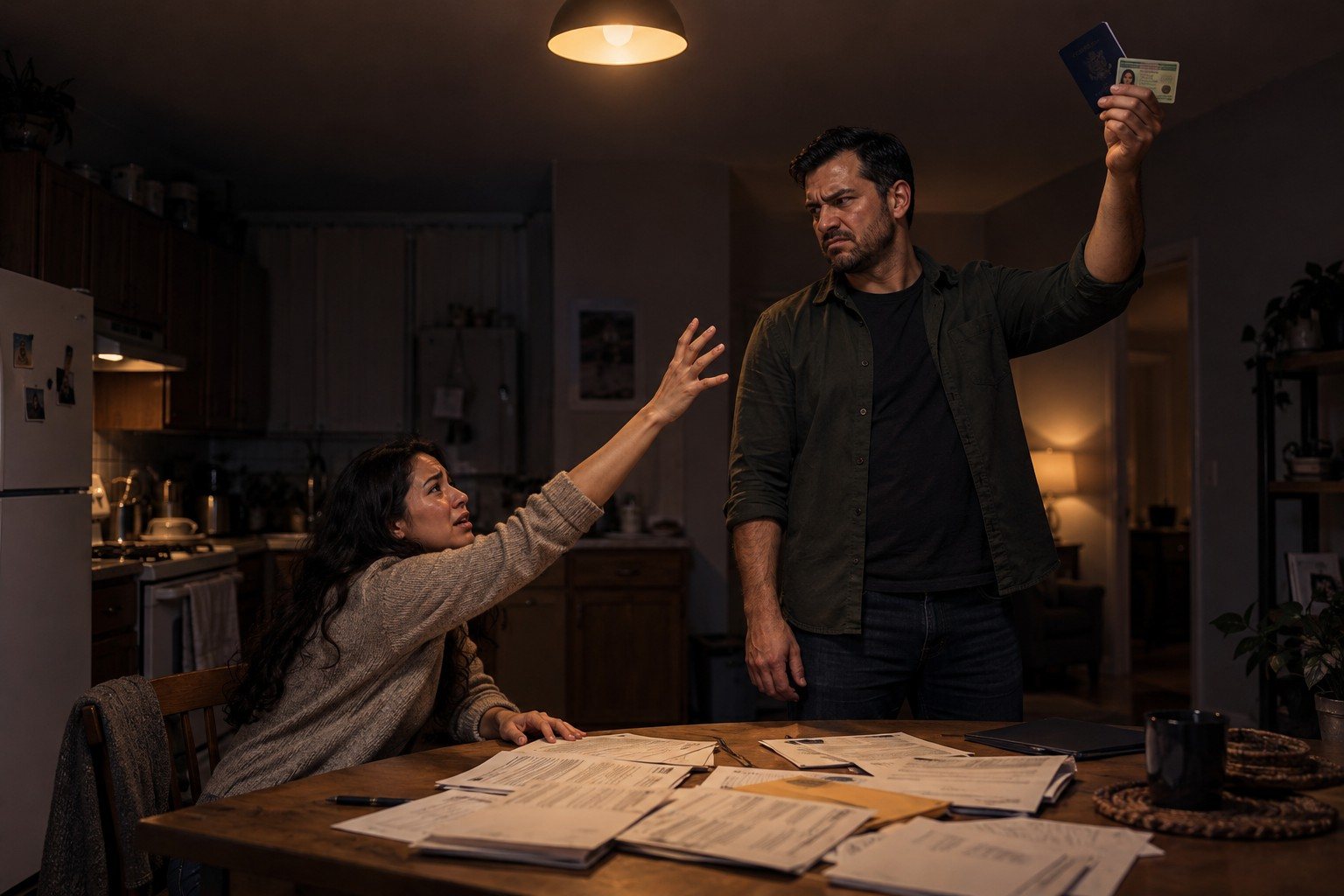
For years the abuser may have told you that your papers depend on them. For a spouse, child or parent of a U.S. citizen or permanent resident, that is not true. The Violence Against Women Act lets you petition for yourself. The abuser is not a party to the case, is not asked to cooperate, and cannot withdraw it.
The self-petition is one form, Form I-360, filed with USCIS. It does not give you a green card by itself. It is the petition the green card is built on, and on approval it opens the door to a work permit and protection from removal while you wait. Each step below has its own page.
If you are in removal proceedings, read VAWA with USCIS or VAWA in immigration court to see how this petition differs from the court case.
Who can file

Who the abuser is to you decides which rule applies. Find your row, then read its page.
| You are | The rule | Authority |
|---|---|---|
| Spouse of a U.S. citizen | Petition as an immediate relative | INA 204(a)(1)(A)(iii) |
| Spouse of a green card holder | Petition in the second preference (F2A) category | INA 204(a)(1)(B)(ii) |
| Former spouse | File within 2 years after the marriage ended, if the end of the marriage is connected to the abuse | INA 204(a)(1)(A)(iii)(II)(aa)(CC)(ccc); 204(a)(1)(B)(ii)(II)(aa)(CC)(bbb) |
| Spouse of an abuser who died or lost status | File within 2 years of the death of a citizen abuser, or of a loss of status tied to domestic violence | INA 204(a)(1)(A)(iii)(II)(aa)(CC)(aaa), (bbb); 204(a)(1)(B)(ii)(II)(aa)(CC)(aaa) |
| Intended spouse | You married in good faith, and the marriage was invalid only because the abuser was already married | INA 204(a)(1)(A)(iii)(II)(aa)(BB); INA 101(a)(50) |
| Child | Unmarried and under 21; filing may wait until 25 if the abuse was a central reason for the delay | INA 204(a)(1)(A)(iv), (B)(iii); 204(a)(1)(D)(v) |
| Parent | Abused by a U.S. citizen son or daughter who is at least 21 | INA 204(a)(1)(A)(vii) |
A spouse can include their children on the petition, whether or not the children were abused (INA 204(a)(1)(A)(iii), (B)(ii); 8 C.F.R. 204.2(c)(4)). See children on your petition. For a longer walk through each door, read who qualifies.
You may file from outside the United States only if the abuser is employed abroad by the U.S. government, is a member of the uniformed services, or subjected you or your child to battery or extreme cruelty in the United States (INA 204(a)(1)(A)(v), (B)(iv)). See survivors abroad.
What a spouse proves

Under INA 204(a)(1)(A)(iii) and (B)(ii) and USCIS Policy Manual Vol. 3, Part D, ch. 2, a spouse shows five things:
- A qualifying marriage, entered in good faith.
- That you, or your child, were battered or subjected to extreme cruelty by your spouse during the marriage.
- That you lived with the abuser during the marriage. There is no minimum period, and if you are in the United States when you file, time together abroad can count (INA 204(a)(1)(A)(iii)(II)(dd); USCIS Policy Manual Vol. 3, Part D, ch. 2).
- Good moral character.
- That you are eligible for the immediate relative or F2A classification.
A requirement that is no longer the law
Older guides, and the regulation itself, list a sixth element: that removal would cause extreme hardship. Congress removed that element from the statute in the Victims of Trafficking and Violence Protection Act of 2000 (Pub. L. 106-386, div. B, title V, sec. 1503). The text of 8 C.F.R. 204.2(c)(1)(i)(G) was never rewritten and still prints it. The statute controls, and the USCIS Policy Manual, Vol. 3, Part D, follows the statute. You do not have to prove hardship to file a self-petition.
Children and parents prove a parallel set of facts about their own relationship. Their pages set out what the ledger confirms so far.
What counts as abuse, and how you prove it

The regulation defines battery or extreme cruelty broadly. It includes any act or threatened act of violence, including forceful detention, that results or threatens to result in physical or mental injury; psychological or sexual abuse or exploitation; and acts that may not look violent on their own but are part of an overall pattern of violence (8 C.F.R. 204.2(c)(1)(vi)). Control through threats, isolation, money or your immigration papers can be part of that pattern. See abuse without violence.
USCIS must consider any credible evidence you submit, and decides how much weight to give it (INA 204(a)(1)(J); 8 C.F.R. 204.2(c)(2)(i)). No police report, protective order or medical record is required. The center of most petitions is your own declaration, supported by whatever exists.
- Any credible evidence: what the standard means in practice.
- Writing your declaration: your account, in your words.
- Evidence without documents: when the abuser kept the papers.
- Good moral character: your affidavit plus police clearances for each place you lived six months or more in the three years before filing (8 C.F.R. 204.2(c)(2)(v)).
If you were arrested or charged
An act or conviction connected to the abuse does not bar good moral character if it is waivable for purposes of the petition (INA 204(a)(1)(C); INA 101(f)). That exception names spouse and child petitions, not abused parents. Every arrest still has to be read closely. Talk to your criminal lawyer before you write anything down about it, and see arrested or charged.
Filing and what follows
As of October 2026 there is no government filing fee for a VAWA Form I-360 (8 C.F.R. 106.2(a)(17)(ii); Form I-360 instructions). Later forms in the case, including the I-485, I-765 and I-131, also carry no government filing fee for a VAWA self-petitioner as of October 2026 (8 C.F.R. 106.3(b)(6)). USCIS changed the VAWA filing addresses on October 7, 2026; check the I-360 form page on the day you mail. We do not reprint the address here.
- Prima facie determination. A finding that the petition shows a prima facie case can make a self-petitioning spouse or child a "qualified alien" for certain public benefits, if the abuse happened in the United States, the benefits agency finds a substantial connection between the abuse and the need for benefits, and the abuser no longer lives in the same household (8 U.S.C. 1641(c); 8 C.F.R. 204.2(c)(6)(i)). Parents are not covered, and no prima facie notice is issued for a petition filed from abroad. See prima facie determination.
- Approval. An approved self-petitioner is eligible for a work permit (INA 204(a)(1)(K)) and may be considered for deferred action on a case-by-case basis (USCIS Policy Manual, Vol. 3, Part D).
- The green card. Approval is the base for adjustment of status. See the green card after VAWA.
We do not publish processing times. USCIS posts its own at uscis.gov/processing-times. What happens between filing and decision is on after you file, with requests for evidence and notices of intent to deny and what to do after a denial.
Life does not stop while the petition is pending. A divorce after you file does not affect it. Remarrying before approval is a basis for denial; remarrying after approval is not a basis to revoke it (8 C.F.R. 204.2(c)(1)(ii); INA 204(h)). If the abuser filed an I-130 for you before, its priority date can carry over to the self-petition (8 C.F.R. 204.2(h)(2)).
Your file is protected, within limits

The government may not disclose information about a VAWA applicant to anyone, with limited exceptions, and may not make an adverse determination of admissibility or deportability using information furnished only by the abuser or the abuser's family (8 U.S.C. 1367(a)(1), (a)(2)). The admissibility rule does not apply if you have been convicted of a crime listed in INA 237(a)(2), and USCIS does not apply it to the denial of an I-360, I-751 or I-765V (PA-2025-34). Nondisclosure ends once an application is denied and all appeals are exhausted. That law does not stop anyone from calling immigration authorities, and it does not bind a state family or criminal court. That is our reading of its scope. Read confidentiality before you decide how and where to keep your papers.
For every survivor
VAWA covers survivors of any gender (INA 204(a)(1)). See men and VAWA, same-sex couples and survivors abroad. If the abuser is not a citizen or green card holder, or you were never married, the self-petition may not fit; read other paths. If you are already in immigration court, start at VAWA in immigration court.
For the ordinary marriage green card, when there is no abuse, visa4love.com is our sister site for marriage and family immigration.
visa4love.comOur sister site for marriage and family immigration, with its own page on the VAWA self-petition.
VAWA on visa4love.com →
Every page in this guide
- Who files: who qualifies, spouse of a U.S. citizen, spouse of a green card holder, former spouse and the 2-year rule, abuser died or lost status, intended spouse, abused child, abused parent, children on your petition.
- What you prove: battery or extreme cruelty, abuse without violence, good-faith marriage, living with the abuser, good moral character.
- Evidence: any credible evidence, writing your declaration, evidence without documents.
- After filing: prima facie determination, after you file, RFEs and NOIDs, I-360 denied.
- Every survivor: men and VAWA, same-sex couples, survivors abroad.
Read next: who qualifies, battery or extreme cruelty, writing your declaration, or confidentiality.
Common questions
Does the abuser have to sign anything or know that I filed?
No. The self-petition is filed by you alone on Form I-360. Federal law, 8 U.S.C. 1367(a)(2), bars the government from disclosing information about your petition to anyone, with limited exceptions. That rule binds the government. It does not control what the abuser suspects or does, so a safety plan made with an advocate still matters.
Is there a government filing fee?
As of October 2026 there is no government filing fee for a VAWA Form I-360 (8 C.F.R. 106.2(a)(17)(ii) and the Form I-360 instructions). USCIS sets and changes fees, so check the Form I-360 page on uscis.gov before you file. Any legal fee is separate from the government fee.
We are divorced. Can I still file?
Possibly. A former spouse may file within 2 years after the marriage ended if there is a connection between the end of the marriage and the battery or extreme cruelty (INA 204(a)(1)(A)(iii)(II)(aa)(CC)(ccc) for spouses of citizens, INA 204(a)(1)(B)(ii)(II)(aa)(CC)(bbb) for spouses of green card holders). A divorce after you file does not affect the petition (8 C.F.R. 204.2(c)(1)(ii)).
Do I need a police report or a protective order?
No single document is required. USCIS must consider any credible evidence, and how much weight it gives each item is in its discretion (INA 204(a)(1)(J); 8 C.F.R. 204.2(c)(2)(i)). Many petitions are built on a detailed declaration supported by whatever records and witness statements exist.
Does VAWA protect men?
Yes. The self-petition provisions in INA 204(a)(1) are written without regard to gender. Husbands, wives, same-sex spouses, children and parents file under the same rules.
The lawyers who will handle your case
One of them calls you back, privately, on your terms.

Talk to a lawyer privately. You decide how we reach you.
Tell us a safe number or email and a safe time, and whether we can leave a message. We never contact the person who hurt you, and we never call from a number or send anything that names this site. The first conversation is free and confidential, in English, Russian, Spanish or Uzbek, with a live interpreter for any other language.