
Including your children on your petition
If you self-petition as an abused spouse, or as an abused child, your own unmarried children under 21 can be included on your petition. They do not have to have been abused themselves. If a child turns 21 before approval, the law keeps that child in the case as a self-petitioner with your priority date.
Current as of October 2026. We re-check this page every quarter and after any change in the law.
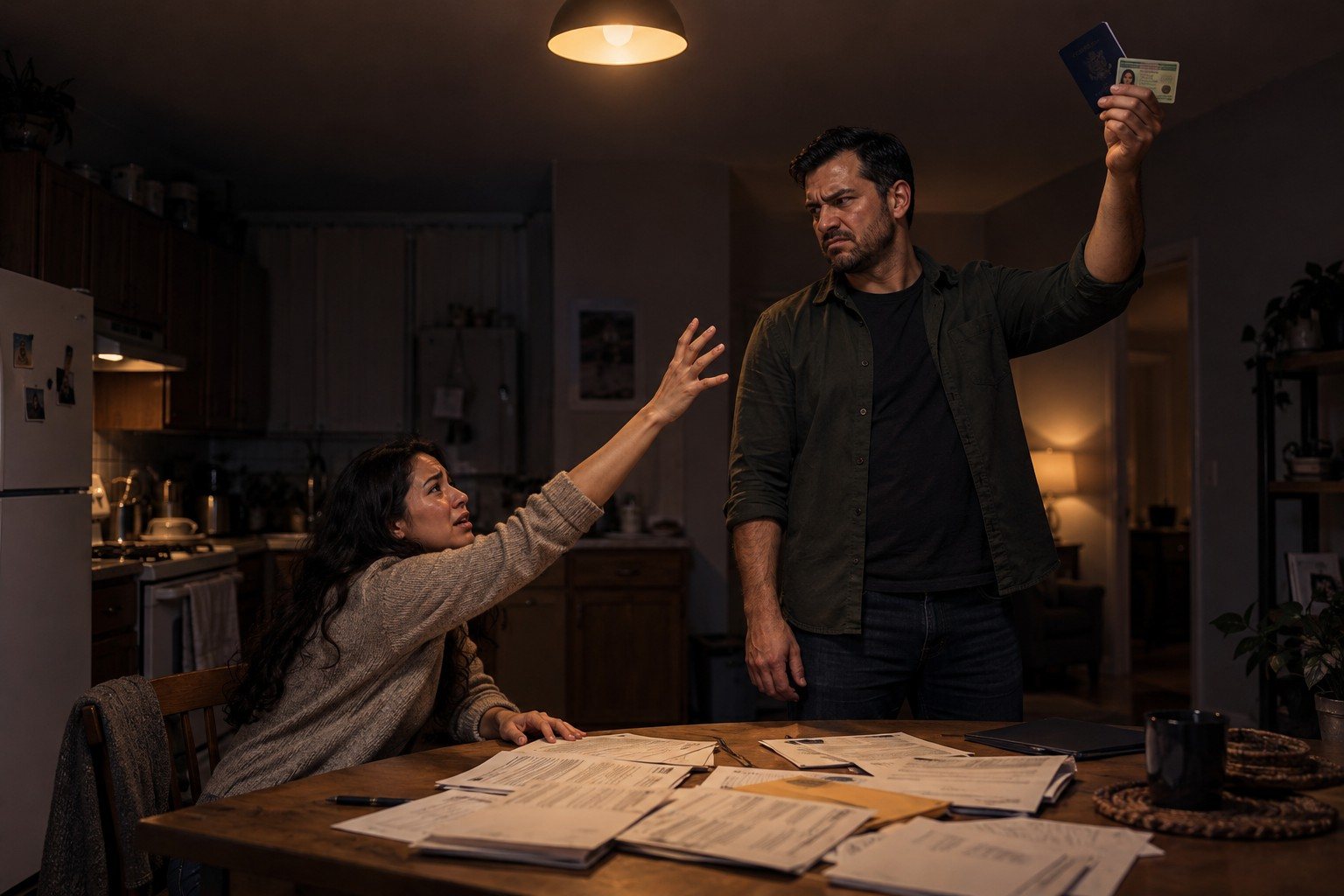
Abusers often use the children as leverage: "you will leave without them," or "they stay with me because they have papers through me." The self-petition lets a parent bring the children into the case. The rule is in INA 204(a)(1)(A)(iii), (iv), (B)(ii) and (iii), with USCIS Policy Manual Vol. 3, Part D, ch. 2(I). The rules on this page are stated as of October 2026.
The basic rule

When you self-petition as the abused spouse of a U.S. citizen or permanent resident, your children may be included as derivatives. It does not matter whether the children were abused (INA 204(a)(1)(A)(iii), (B)(ii); 8 C.F.R. 204.2(c)(4)).
The spousal self-petition also covers the case where the abuser harmed your child rather than you. A spouse whose child was battered or subjected to extreme cruelty by the abuser during the marriage may self-petition (INA 204(a)(1)(A)(iii), (B)(ii); 8 C.F.R. 204.2(c)(1)(i)). See spouse of a U.S. citizen and spouse of a green card holder.
Who can include children, and which children

- Self-petitioning spouses and self-petitioning children may include their own children who are unmarried and under 21 at filing. Self-petitioning parents may not (3 USCIS-PM D.2(I)).
- Derivatives get the same classification and priority date as you.
- A child may be added later. A child, including one born after approval, may be added at the green card or immigrant visa stage without a new petition.
- At the green card stage each derivative files their own Form I-485. A derivative of a person abused by a U.S. citizen is treated as an immediate relative and may file with your I-485; a derivative of the spouse of a permanent resident shares your preference category and priority date (USCIS, green card for a VAWA self-petitioner).
A self-petitioning child's own children: the regulation is out of step
8 C.F.R. 204.2(e)(4) says a self-petitioning child's own child cannot be a derivative. The statute says the child's petition covers "any child of the alien" (INA 204(a)(1)(A)(iv), (B)(iii)), and the Policy Manual allows it (3 USCIS-PM D.2(I)). We follow the statute and the Policy Manual.
The relationship is shown by the child's civil birth certificate naming you. A father of a child born out of wedlock also shows a bona fide parent-child relationship, for example through support records, school or agency records or affidavits. For a stepchild, show your marriage to the child's parent took place before the child turned 18, and that prior marriages ended. For an adopted child, the adoption decree (3 USCIS-PM D.2(B)(3)).
When a child turns 21
Cases take time, and children have birthdays. Under INA 204(a)(1)(D)(i)(III), (D)(ii), a derivative child who turns 21 before the petition is approved is treated as a self-petitioner, and keeps your priority date, as long as the child remains unmarried (USCIS Policy Manual Vol. 3, Part D, ch. 3). The birthday does not push the child to the back of the line.
For the spouse of a permanent resident, the priority date matters because F2A adjustment waits for a current date in the Visa Bulletin (INA 203(a)(2)(A)). If the abuser naturalizes after you file, the petition converts to the immediate relative classification (INA 204(a)(1)(B)(v)). See F2A and the Visa Bulletin.
What usually helps

USCIS must consider any credible evidence (INA 204(a)(1)(J)).
- Each child's birth certificateShows you as the parent.A certified copy can usually be ordered from the issuing office. If the abuser holds the originals, see documents the abuser took.
- Where the children have livedSchool or medical records that show the household.Your declaration of where the children have lived and with whom.
- Any harm to the childrenIf the abuser harmed a child, the records you have: school, pediatric, counseling.Your declaration and statements from people who saw it. See evidence without documents.
Custody and the immigration case are separate
The immigration case does not decide custody, and a family court does not decide the immigration case. What you file in one may be seen in the other. A safety plan for you and the children is made with an advocate; custody questions go to a family lawyer. See divorce, custody and VAWA.
When the child is the one who was abused by a parent
A child abused by a U.S. citizen or permanent resident parent may self-petition on their own, if unmarried and under 21 (INA 204(a)(1)(A)(iv), (B)(iii); 8 C.F.R. 204.2(e)), or until age 25 if the abuse was at least one central reason for the delay (INA 204(a)(1)(D)(v)). See abused child. Some children may also qualify for Special Immigrant Juvenile classification on a state-court finding of abuse, neglect or abandonment (INA 101(a)(27)(J); 8 C.F.R. 204.11); see SIJ for abused children.
Read next: abused child, divorce, custody and VAWA, the green card after VAWA, or the self-petition overview.
Common questions
Do my children have to have been abused to be included?
No. A self-petitioning spouse's children may be included as derivatives whether or not they were abused (INA 204(a)(1)(A)(iii), (B)(ii); 8 C.F.R. 204.2(c)(4)).
What happens if my child turns 21 while the petition is pending?
A derivative child who turns 21 before approval is treated as a self-petitioner, keeping your priority date (INA 204(a)(1)(D)(i)(III), (D)(ii)). The child does not lose their place because of the birthday.
I am filing as an abused parent. Can my other children be included?
No. A self-petitioning parent cannot include derivatives. A child listed on a parent's petition gets no benefit from it, though the petition is not denied for it (3 USCIS-PM D.2(I), as of October 2026).
I had a baby after my petition was approved. Do I need a new petition?
No. A child, including one born after approval, may be added at the green card or immigrant visa stage without a new petition (3 USCIS-PM D.2(I), as of October 2026).
Is the abuser told that the children are included?
The government may not disclose information about a VAWA applicant to anyone, with limited exceptions (8 U.S.C. 1367(a)(2), (b)). That rule binds the government. Custody papers and school records are a separate matter, so talk to your lawyer about what any family-court filing will show.
Can my child file a separate petition?
A child who was abused by a U.S. citizen or permanent resident parent may self-petition on their own if unmarried and under 21, or until 25 if the abuse was a central reason for the delay (INA 204(a)(1)(A)(iv), (B)(iii); 204(a)(1)(D)(v)). Whether to rely on inclusion, a separate petition, or both is decided on the facts.
The lawyers who will handle your case
One of them calls you back, privately, on your terms.



Talk to a lawyer privately. You decide how we reach you.
Tell us a safe number or email and a safe time, and whether we can leave a message. We never contact the person who hurt you, and we never call from a number or send anything that names this site. The first conversation is free and confidential, in English, Russian, Spanish or Uzbek, with a live interpreter for any other language.