
Abused by your U.S. citizen spouse
If your husband or wife is a U.S. citizen and abused you, you can file your own petition as an immediate relative. You do not need their signature, their sponsorship or their permission. The petition is Form I-360, and you file it yourself.
Current as of October 2026. We re-check this page every quarter and after any change in the law.
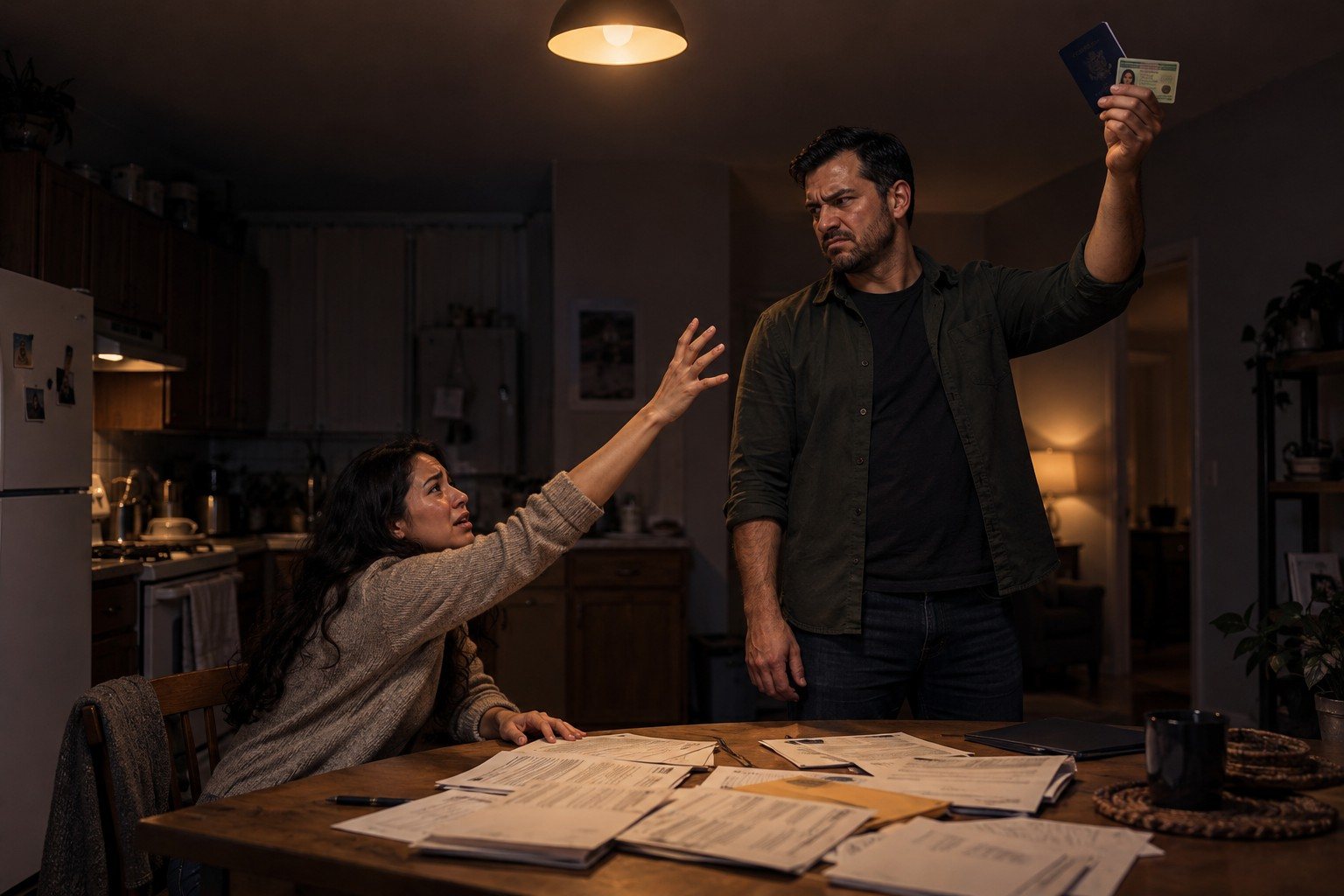
The law that lets you file is INA 204(a)(1)(A)(iii), 8 U.S.C. 1154(a)(1)(A)(iii), with the regulation at 8 C.F.R. 204.2(c). It gives the abused spouse of a U.S. citizen the same immediate relative classification the citizen could have petitioned for, without the citizen.
Many people in this position were told that only the citizen spouse could file, or that a pending case would be withdrawn if they did not obey. Neither controls a self-petition. Your case is yours.

What you show

Under INA 204(a)(1)(A)(iii) and USCIS Policy Manual Vol. 3, Part D, ch. 2, as of October 2026:
- A qualifying marriage to a U.S. citizen, entered in good faith. You married to build a life, not to get papers. See good-faith marriage.
- Battery or extreme cruelty during the marriage, against you or your child. See battery or extreme cruelty.
- You lived with the abuser during the marriage. No minimum period. If you are in the United States when you file, a home you shared abroad can count (USCIS Policy Manual Vol. 3, Part D, ch. 2). See living with the abuser.
- Good moral character. See good moral character.
- Eligibility for immediate relative classification.
You may file from outside the United States only if your spouse is employed abroad by the U.S. government, is a member of the uniformed services, or subjected you or your child to battery or extreme cruelty in the United States (INA 204(a)(1)(A)(v)). Each element is proved by a preponderance of the evidence, "more likely than not" (3 USCIS-PM D.5(B)).
What usually helps

USCIS must consider any credible evidence, and decides the weight (INA 204(a)(1)(J); 8 C.F.R. 204.2(c)(2)(i)). No single item below is required. Each line says what to use if you cannot get it.
- Proof of your spouse's citizenshipA U.S. birth certificate, unexpired U.S. passport, naturalization or citizenship certificate, or Consular Report of Birth Abroad (FS-240), or a copy of one (3 USCIS-PM D.2(B)(1)).If the abuser keeps these, give identifying details (name, date and place of birth, Social Security number if known) and USCIS searches its records. The burden stays on you, so add any record that mentions their citizenship. See documents the abuser took.
- Your marriage certificateThe legal fact of the marriage.A certified copy can usually be ordered from the office that issued it.
- Your declarationYour account of the relationship and the abuse, in your words.There is no substitute, but it can be written over several sessions. See writing your declaration.
- Records of the abuseMessages, medical or counseling records, police or court records where they exist.Statements from people who saw what happened or saw its effect on you. See evidence without documents.
- Good moral characterYour affidavit and police clearances for each place you lived six months or more in the three years before filing (8 C.F.R. 204.2(c)(2)(v)).If a clearance cannot be obtained, say why and offer what you have; USCIS must consider any credible evidence (INA 204(a)(1)(J)).
If the marriage ends, or the citizen dies

- Divorce after you file does not affect the petition. Remarriage before approval is a basis for denial; remarriage after approval is not a basis to revoke it (8 C.F.R. 204.2(c)(1)(ii); INA 204(h)). See divorce, remarriage and your case.
- Divorce before you file. You have 2 years after the marriage ended, if the end of the marriage is connected to the abuse (INA 204(a)(1)(A)(iii)(II)(aa)(CC)(ccc)). See the 2-year rule.
- The citizen died within the 2 years before filing, or lost or renounced citizenship in that period in a way related to an incident of domestic violence: you may still file (INA 204(a)(1)(A)(iii)(II)(aa)(CC)(aaa), (bbb)). See abuser died or lost status.
If you already hold a two-year conditional green card through this marriage, a separate route may fit: the battered-spouse waiver of the joint I-751 filing (INA 216(c)(4)(C)). See the I-751 waiver.
The green card: you can file it now

Because a citizen's spouse is an immediate relative, not subject to the numerical limits (INA 201(b)(2)(A)(i)), there is no Visa Bulletin wait. You may file Form I-485 at any time: together with the I-360, while it is pending, or after approval. The green card itself still requires an approved I-360 (3 USCIS-PM D.4(A), D.5(D)(2), as of October 2026). A pending I-485 lets you apply for a work permit under category (c)(9) before the I-360 is approved. VAWA self-petitioners pay no government filing fee for the I-485 or the I-765 (8 C.F.R. 106.3(b)(6)).
If you already have a pending I-485 based on the abuser's I-130, you can tell the field office, in person or by mail with a safe address, that you filed or will file a self-petition within 30 days, and ask USCIS to hold the I-485 and switch its basis. If no I-360 is filed within 30 days, USCIS continues on the I-130. Section 1367 protection applies once you give notice (3 USCIS-PM D.5(E)).
After approval

- An approved self-petitioner is eligible for a work permit (INA 204(a)(1)(K)) and may be considered for deferred action on a case-by-case basis (USCIS Policy Manual, Vol. 3, Part D). See work permit.
- Once the petition is approved, you may apply to adjust status even if you entered without inspection (INA 245(a), opening clause). The present-without-admission ground does not apply where you show a substantial connection between the abuse and the unlawful entry (INA 212(a)(6)(A)(ii)). See entry without inspection.
- You are exempt from the public charge ground and do not need an affidavit of support (INA 212(a)(4)(C)(i), (E)(i)).
- After permanent residence, you may apply to naturalize after 3 years, without the marital-union requirement (INA 319(a)). See citizenship after VAWA.
We do not publish processing times. USCIS posts them at uscis.gov/processing-times. The full sequence is on the green card after VAWA.
Read next: good-faith marriage, writing your declaration, confidentiality, or the self-petition overview.
Common questions
My spouse said they would withdraw my papers. Can they stop this petition?
No. A self-petition is your own filing under INA 204(a)(1)(A)(iii). The abuser is not the petitioner and has no role in it. If the abuser once filed an I-130 for you, that petition was theirs; the self-petition is separate.
Do I need a joint sponsor or an affidavit of support for the green card?
No. VAWA self-petitioners are exempt from the public charge ground of inadmissibility and do not file Form I-864 (INA 212(a)(4)(C)(i), (E)(i)).
I entered the United States without inspection. Can I still get a green card here?
A person with an approved VAWA self-petition may adjust status even without inspection and admission or parole (INA 245(a)). The present-without-admission ground does not apply to a self-petitioner who shows a substantial connection between the abuse and the unlawful entry (INA 212(a)(6)(A)(ii)). Other grounds of inadmissibility still need review.
Can I file for the green card at the same time as the I-360?
Yes. As the spouse of a U.S. citizen you are an immediate relative, and an immediate-relative visa is always available, so you may file Form I-485 together with the I-360, while it is pending, or after approval. The green card itself still requires an approved I-360 (3 USCIS-PM D.4(A), D.5(D)(2), as of October 2026). A pending I-485 also lets you apply for a (c)(9) work permit.
How soon can I become a citizen?
A person who obtained permanent residence as the battered spouse or child of a U.S. citizen may apply for naturalization after 3 years, without the usual marital-union requirement (INA 319(a)).
The lawyers who will handle your case
One of them calls you back, privately, on your terms.

Talk to a lawyer privately. You decide how we reach you.
Tell us a safe number or email and a safe time, and whether we can leave a message. We never contact the person who hurt you, and we never call from a number or send anything that names this site. The first conversation is free and confidential, in English, Russian, Spanish or Uzbek, with a live interpreter for any other language.