
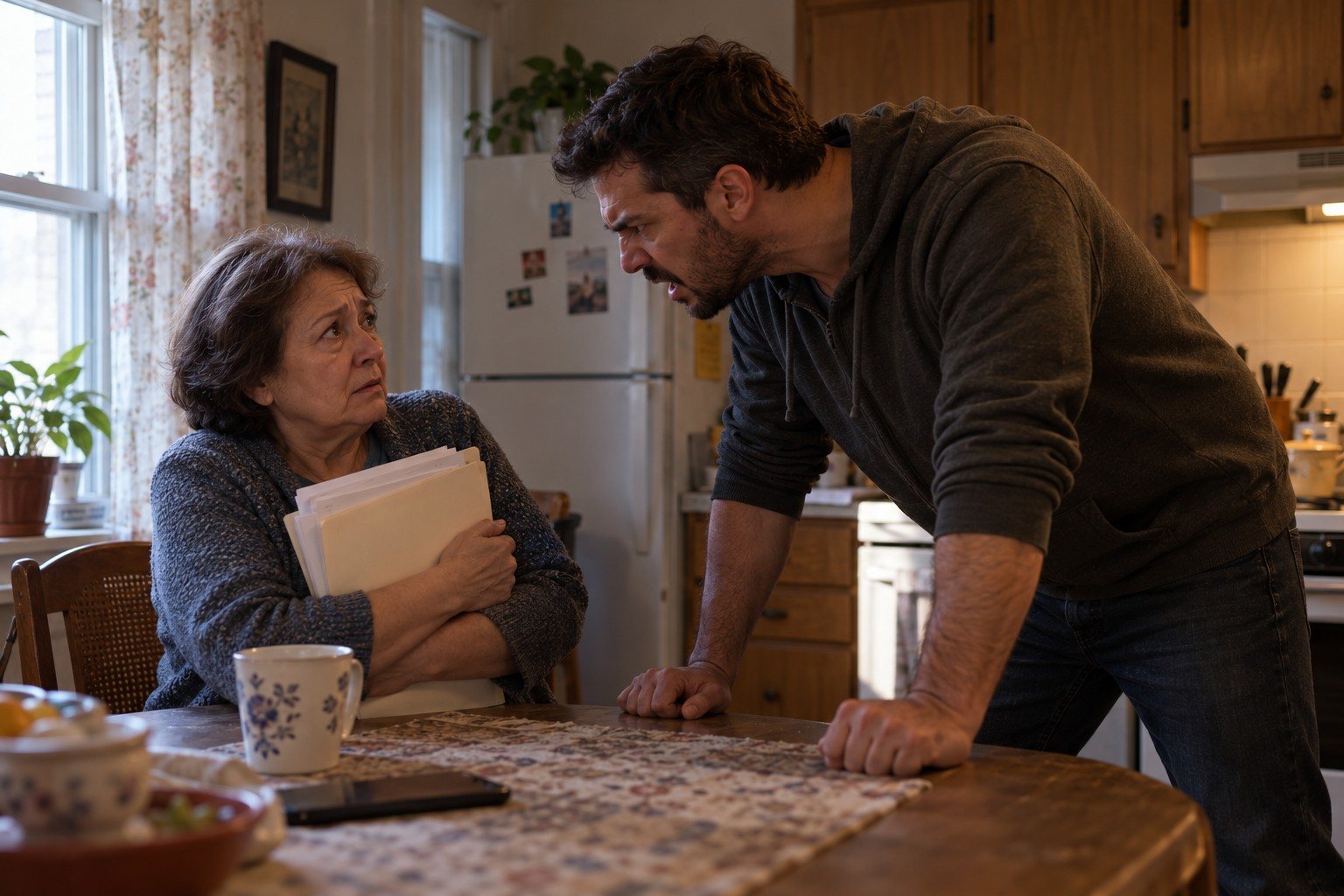
Abused by your adult U.S. citizen son or daughter
If your son or daughter is a U.S. citizen, is at least 21, and abused you, you can file your own petition. You do not need them to sponsor you, and you do not need their permission. Congress added this door in 2005.
Current as of October 2026. We re-check this page every quarter and after any change in the law.

Parents who came to the United States through a son or daughter are often told the same thing abused spouses are told: your status depends on me. Since VAWA 2005 (Pub. L. 109-162), INA 204(a)(1)(A)(vii) lets an abused parent of a U.S. citizen son or daughter file without them.
The elements

Under INA 204(a)(1)(A)(vii)(I) to (V), you show that:
- You are the parent of a U.S. citizen son or daughter. That includes a son or daughter who, within the past 2 years, lost or renounced citizenship in a way related to domestic violence, or died.
- You have good moral character. See good moral character.
- You are eligible as an immediate relative of the citizen.
- You reside or have resided with the citizen son or daughter. See living with the abuser.
- The son or daughter battered you or subjected you to extreme cruelty. See battery or extreme cruelty.
These rules are stated as of October 2026.
Who counts

- The son or daughter must be a U.S. citizen, 21 or older at filing, and the abuse must have happened while they were 21 or older. Parents of permanent resident sons and daughters are not eligible (3 USCIS-PM D.2(B)(4), D.2(E)).
- The parent may be a biological parent, a stepparent or an adoptive parent. A stepparent qualifies if the marriage creating the step relationship took place before the son or daughter turned 18. An adoptive parent must show 2 years of legal custody and 2 years of joint residence (INA 101(b)(1)(E); 3 USCIS-PM D.2(B)(4)).
Limits that apply only to parents

- No derivatives. A self-petitioning parent cannot include children on the petition. A listed child gets no benefit, but the petition is not denied for it (3 USCIS-PM D.2(I)).
- If the son or daughter died, you may file within 2 years after the death, if they were at least 21 at death (3 USCIS-PM D.3(D)(1)).
- If the son or daughter loses or renounces citizenship after you file, you are no longer eligible. This is different from spouses and children (3 USCIS-PM D.3(E)(2)). Before filing, a loss related to domestic violence within the past 2 years still lets you file, if they were 21 or older at the loss.
- The abuse-connected good moral character exception does not name parents. INA 204(a)(1)(C) names petitions under (A)(iii), (A)(iv), (B)(ii) and (B)(iii), not (A)(vii). A parent with an arrest or conviction is measured against INA 101(f) without it. Talk to us before filing.
- Public benefits. USCIS issues a Notice of Prima Facie Case to parents too, but self-petitioning parents are not "qualified aliens" for federal public benefits (8 U.S.C. 1641(c); 3 USCIS-PM D.5(A)).
What abuse by an adult child can look like
Abuse by an adult son or daughter does not always look like the abuse people picture. It may be violence. It may be threats, isolation from friends and other family, control of money and papers, or threats to have you deported or sent away. Under the regulation that defines the term for spouses, extreme cruelty includes psychological abuse and acts that may not look violent on their own but are part of an overall pattern of violence (8 C.F.R. 204.2(c)(1)(vi)). Under the December 2025 Policy Manual (PA-2025-33), there is no formula. Hurtful conduct alone, or adverse interactions of limited severity, is not enough for "extreme" cruelty; the conduct must reflect an intent to gain or maintain power and control (3 USCIS-PM D.2(E)(1), as of October 2026). See abuse without violence and threats of deportation.
What usually helps

USCIS must consider any credible evidence (INA 204(a)(1)(J)). No single record is required.
- Proof that you are the parentYour son or daughter's birth certificate showing you as a parent. A father of a child born out of wedlock also shows a bona fide parent-child relationship; a stepparent shows the marriage before the child turned 18; an adoptive parent shows the adoption decree (3 USCIS-PM D.2(B)(3)-(4)).If the abuser holds it, a certified copy can often be ordered from the issuing office. See documents the abuser took.
- Proof of their citizenship and ageA U.S. birth certificate, unexpired U.S. passport, naturalization or citizenship certificate, or Consular Report of Birth Abroad (3 USCIS-PM D.2(B)(1)).Give identifying details (name, date and place of birth, Social Security number if known) and USCIS searches its records. The burden stays on you.
- Proof you lived togetherLeases, mail, bank, school or medical records with a shared address, and affidavits (3 USCIS-PM D.2(F)).Detailed affidavits from friends and family who knew the household.
- Your declarationWhat happened, in order, in your own words and your own language.There is no substitute. It can be written over several sessions, with an interpreter. See writing your declaration.
- CorroborationMedical or counseling records, bank records that show control of money, messages, statements from relatives, neighbors or clergy.See evidence without documents.
Your file and your safety

The government may not disclose information about your petition to anyone, with limited exceptions, and may not make an adverse determination of admissibility or deportability using information furnished only by the abuser or the abuser's family (8 U.S.C. 1367(a)(1), (a)(2)). The admissibility rule does not apply if you have been convicted of a crime listed in INA 237(a)(2), and USCIS does not apply it to the denial of an I-360, I-751 or I-765V (PA-2025-34). That does not stop anyone from calling immigration authorities, and it does not bind a state court. That is our reading of its scope. See confidentiality and the safe filing checklist.
If you were arrested or charged, including on a family member's complaint, talk to your criminal lawyer before you write anything down, and see arrested or charged.
After approval

As the parent of a U.S. citizen you are an immediate relative, so you may file the green card application (Form I-485) together with the I-360, while it is pending, or after approval; the green card itself still needs an approved I-360 (3 USCIS-PM D.4(A), D.5(D)(2), as of October 2026). An approved self-petitioner is eligible for a work permit (INA 204(a)(1)(K)) and may be considered for deferred action on a case-by-case basis (USCIS Policy Manual, Vol. 3, Part D). VAWA self-petitioners are exempt from the public charge ground and file no affidavit of support (INA 212(a)(4)(C)(i), (E)(i)), and once the petition is approved may adjust status even after an entry without inspection (INA 245(a), opening clause); the present-without-admission ground does not apply where the abuse and the unlawful entry are substantially connected (INA 212(a)(6)(A)(ii)). See the green card after VAWA. We do not publish processing times; USCIS posts them at uscis.gov/processing-times.
Read next: who qualifies, abuse without violence, the U visa, or the self-petition overview.
Common questions
My son or daughter has a green card, not citizenship. Can I self-petition?
The parent self-petition in INA 204(a)(1)(A)(vii) covers abuse by a U.S. citizen son or daughter who is at least 21. If the abuser is a permanent resident, this provision does not fit. The U visa may, because domestic violence is a qualifying crime and the abuser's status does not matter (INA 101(a)(15)(U)(iii)).
My child pays the bills and controls my papers. Is that abuse?
It can be part of it. Extreme cruelty is not limited to physical violence, and acts that do not look violent on their own can be part of an overall pattern of violence. How the definition applies to a parent's case depends on the whole record, which is why the declaration matters.
Will my son or daughter be told?
The government may not disclose information about a VAWA applicant to anyone, with limited exceptions (8 U.S.C. 1367(a)(2), (b)). That rule binds the government. It does not control what someone in the same home might notice, so a safety plan made with an advocate matters.
Can I work while the petition is pending?
The VAWA work permit in category (c)(31) needs an approved I-360 (INA 204(a)(1)(K)). Before approval, a parent who filed a green card application (Form I-485) with the I-360 may apply for a work permit as an adjustment applicant under category (c)(9) (Form I-765 instructions; 3 USCIS-PM D.5(D)(2), as of October 2026). Approved self-petitioners may also be considered for deferred action case by case.
Can I include my other children on my petition?
No. A self-petitioning parent cannot include derivatives. Listing a child gives that child no benefit, though the petition is not denied for it (3 USCIS-PM D.2(I), as of October 2026). Each family member needs their own basis.
My abusive son or daughter died. Can I still file?
Yes, within 2 years after the death, if your son or daughter was at least 21 when they died (INA 204(a)(1)(A)(vii); 3 USCIS-PM D.3(D)(1), as of October 2026).
The lawyers who will handle your case
One of them calls you back, privately, on your terms.



Talk to a lawyer privately. You decide how we reach you.
Tell us a safe number or email and a safe time, and whether we can leave a message. We never contact the person who hurt you, and we never call from a number or send anything that names this site. The first conversation is free and confidential, in English, Russian, Spanish or Uzbek, with a live interpreter for any other language.